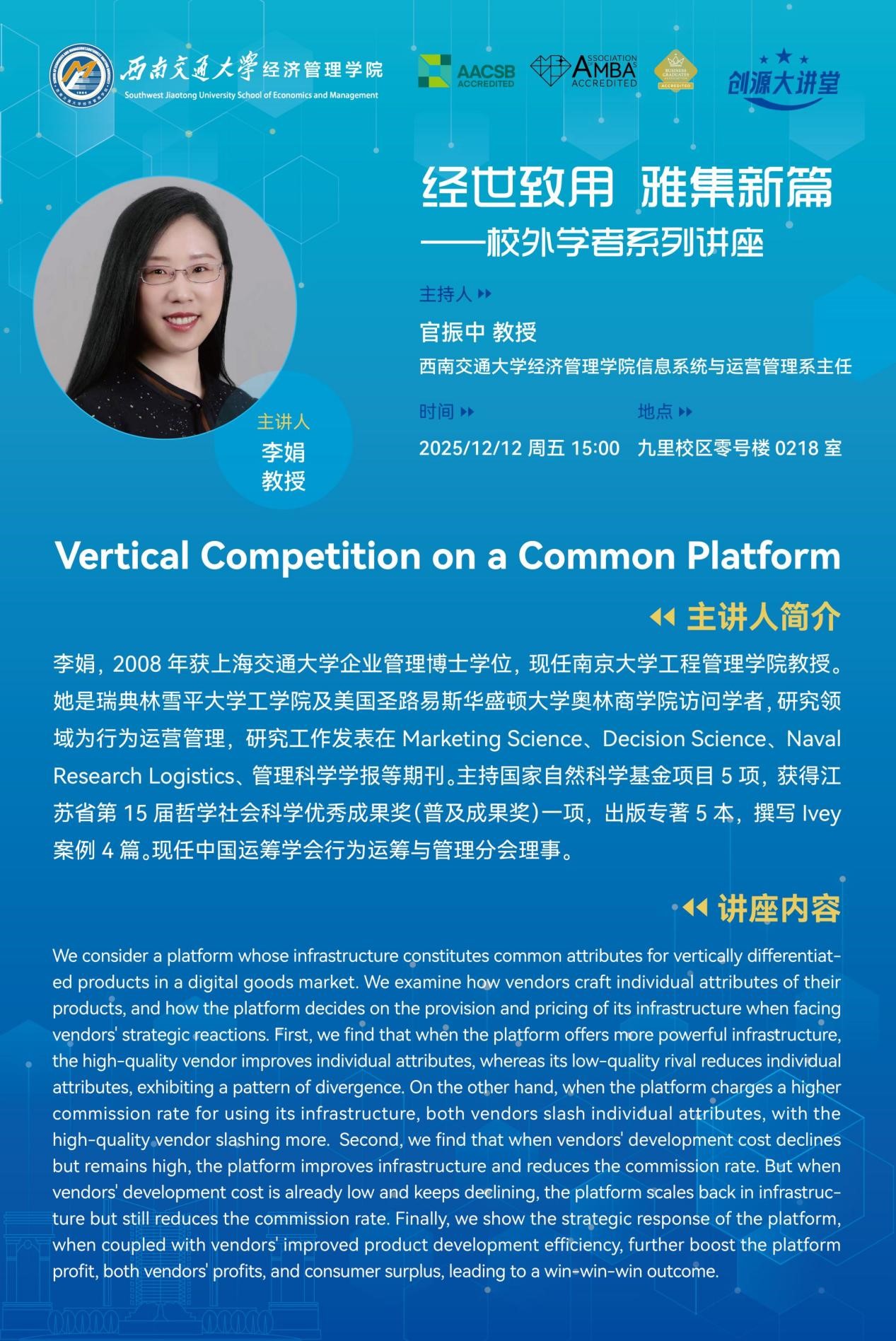
Speaker Profile
Dr. LI Juan is a Professor at the School of Management & Engineering at Nanjing University. She received her Ph.D. in Business Administration from Shanghai Jiao Tong University in 2008 and has held visiting scholar positions at Linköping University in Sweden and the Olin Business School at Washington University in Saint Louis. Her research focuses on behavioral operations management, and her work has appeared in leading journals such as Marketing Science, Decision Sciences, and Naval Research Logistics, as well as top Chinese journals like the Journal of Management Sciences in China. An accomplished researcher, Prof. LI has led five projects funded by the National Natural Science Foundation of China (NSFC). Her contributions extend beyond traditional scholarship; she has authored five monographs, developed four Ivey Business School cases, and received the Jiangsu Provincial Philosophy and Social Sciences Outstanding Achievement Award for her work in knowledge popularization. She is also an active member of the academic community, serving as a council member for the Behavioral Operations Management Society of the Operations Research Society of China.
Abstract
We consider a platform whose infrastructure constitutes common attributes for vertically differentiated products in a digital goods market. We examine how vendors craft individual attributes of their products, and how the platform decides on the provision and pricing of its infrastructure facing vendors’ strategic reactions. First, we find that when the platform offers its more powerful infrastructure, the high-quality vendor improves individual attributes, whereas its low-quality rival reduces individual attributes, exhibiting a pattern of divergence. On the other hand, when the platform charges a higher commission rate for using its infrastructure, both vendors slash individual attributes, with the high-quality vendor slashing more. Second, we find that when vendors’ development cost declines but remains high, the platform improves infrastructure and reduces the commission rate. But when vendors’ development cost is already low and keeps declining, the platform scales back infrastructure but still reduces the commission rate. Finally, we show the strategic response of the platform, when coupled with vendors’ improved product development efficiency, further boosts the platform profit, both vendors’ profits, and consumer surplus, leading to a win-win-win outcome.
Date/Time: December 12, 2025, 3:00 p.m.
Venue: Room 0218, Teaching Building 0, Jiuliu Campus